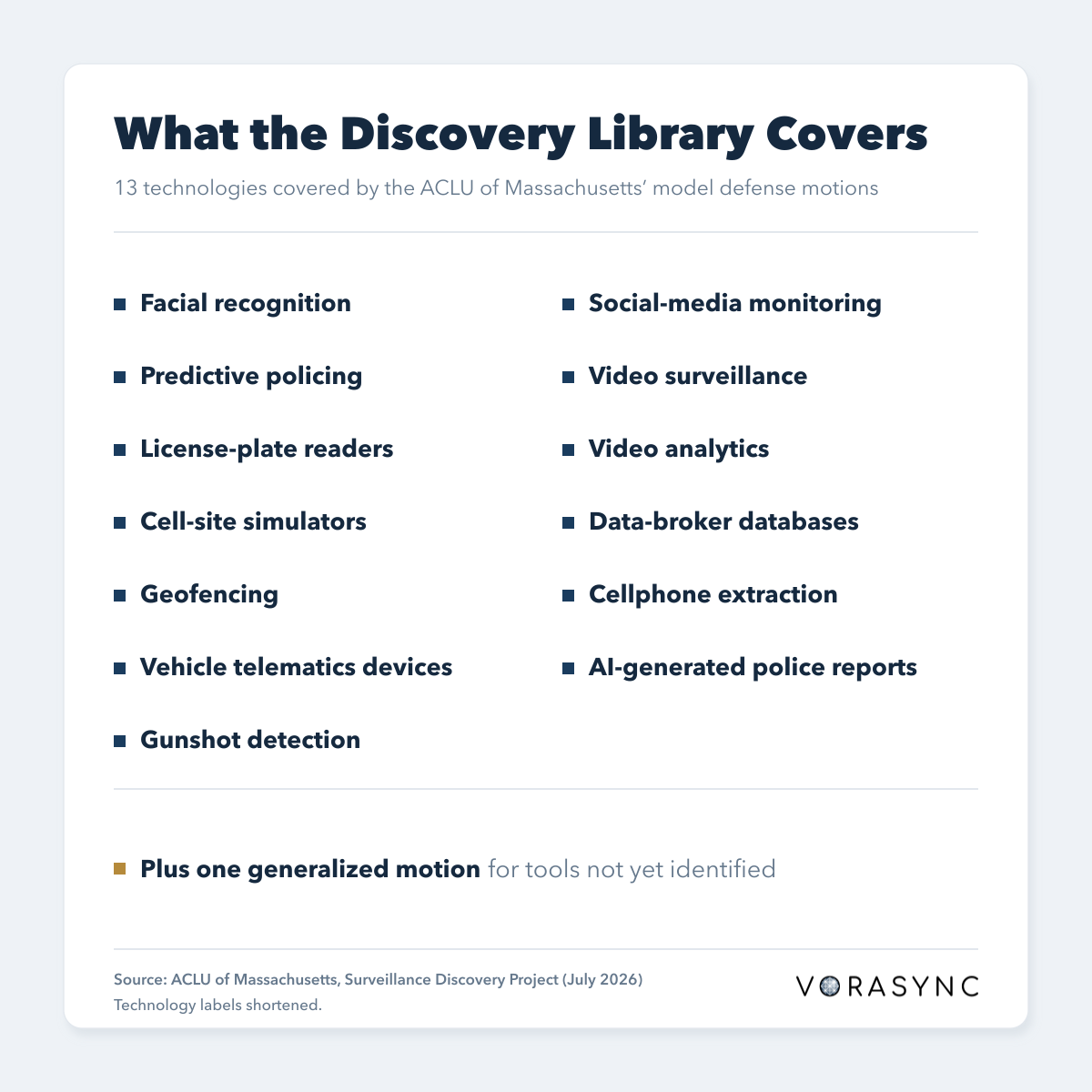
Massachusetts defense lawyers have a new way to probe whether advanced police technology helped build a case. On Monday, the state’s ACLU chapter launched a password-protected library open only to verified defense attorneys. Its motion bank covers issues including facial recognition technology and ALPRs.
The motions are meant to identify tools that may have generated an investigative lead without appearing in police accounting, and to preserve government or vendor records before deletion. Similar resources are made by the National Association of Criminal Defense Lawyers and the Innocence Project, but the Massachusetts templates themselves are restricted.
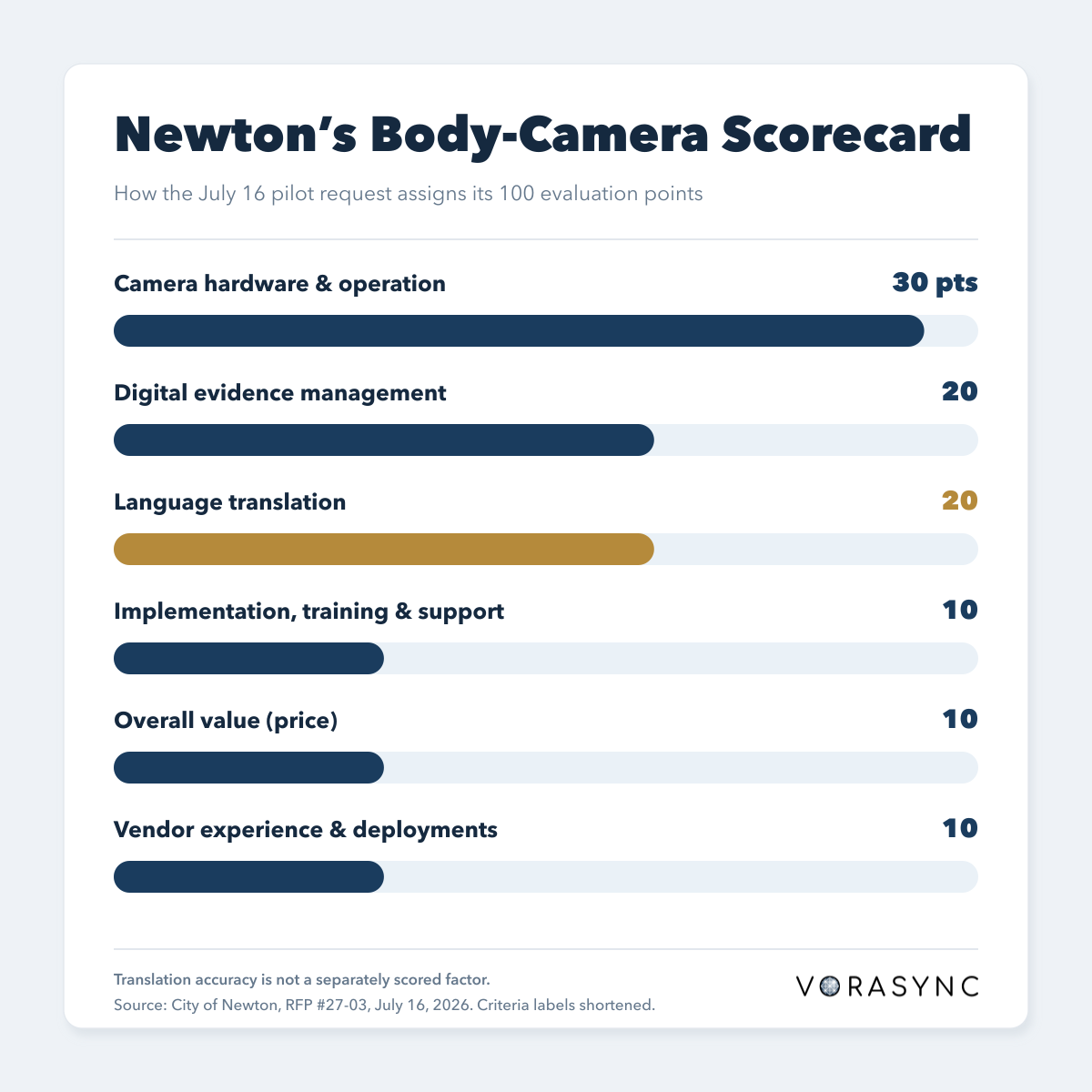
Newton, Massachusetts, a small city west of Boston, is treating live language translation as a major body-camera purchasing criterion—worth 20 of 100 points, as much as its entire evidence-management system and twice as much as price—even though its published scoring matrix does not measure translation accuracy.
Plain Thinking has covered the technology surfacing in Philadelphia for the World Cup and smaller towns like Moline, Illinois. Twenty miles west of Baltimore, Howard County last week announced that every deputy would get the technology. Officials there say nobody is assigned to verify the translations, while the vendor says translation outputs should not be used as evidence for prosecution or in court unless human-certified.
Three police officers in Fayetteville, Georgia, were fired but not arrested after Flock’s new AI-assisted audit tool flagged alleged personal searches involving their own plates and those of friends or relatives. In a separate case in Richmond County, Georgia, three sheriff’s officers were fired and charged over alleged personal use of plate-reader searches, although reports do not indicate whether AI detected their conduct.
Government counsel in Michigan was warned but not sanctioned for an apparent AI hallucination in filings. (W.D. Mich.)
Effective Monday, smart glasses are now banned across New York state courts. (New York Courts)
Berkeley, California, and Huntington, West Virginia, are advancing broad public-safety technology initiatives involving ALPRs, surveillance cameras and drones. (City of Berkeley; WV MetroNews)
A divided Ninth Circuit held that police had to stop a computer search once evidence undermined the warrant’s probable-cause basis, suppressing child-abuse files found afterward. (9th Cir.)
New laws in Hawaii put civil remedies on deepfakes and impose stricter safeguards for AI companion services. (Office of the Governor)
New York City missed its deadline to create an “Algorithmic Accountability” office even as AI use within city agencies may be expanding. (City & State New York)
About Plain Thinking
Grant Morgan is an attorney, former prosecutor and former Tribune Publishing reporter who covered Gary, Indiana, and Chicago’s northern suburbs. Plain Thinking covers AI and consequential technology affecting lawyers, police and courts.
Every Tuesday and Friday · Get Plain Thinking by email · LinkedIn
If an issue includes paid placements, they’ll be clearly labeled. Companies don’t pay for editorial inclusion.