
|
Counter-Droning Tennis
|
The NYPD is breaking new ground for local police with authority to disable drones at the U.S. Open, which runs through Sept. 13. Previously, local police could track drones but generally needed federal agents to hijack them in flight. That changed with December 2025’s Safer Skies Act. Now, trained NYPD personnel can electronically take control of drones and land them safely.
Police are using more drones, but tariffs, procurement systems and privacy concerns are shaping how agencies adopt them. The U.S. administration this month imposed tariffs of up to 100 percent on some drone imports. Separately, state and local agencies are being onboarded to a counterdrone marketplace built by Kaizen Laboratories. In Apex, North Carolina, residents’ privacy concerns prompted the town council to delay a five-year Axon drone package and send it for further review.
Forensic Labs
Anthropic, one of the major U.S. AI firms, is trying to standardize AI interaction with laboratory equipment. Yesterday, the company released its Model Hardware Standard, which lets an agent discover and coordinate instruments from different vendors, from microscopes to liquid handlers to robotic arms. Anthropic’s YouTube releases on the technology show automated microscope handling, among other uses.
MHS is brand new, but forensic labs are already looking at modernizing workflows. Michigan’s crime lab recently called its male-DNA screening workflow on swabs from sexual assault kits “fully automated,” while Idaho is building a $29 million lab with stated plans for whole-genome sequencing, an intensive process usually outsourced to third-party labs. Neither project uses Anthropic’s system, but the prospect of agent-controlled instruments promises to cut down on integrations with myriad lab vendors.
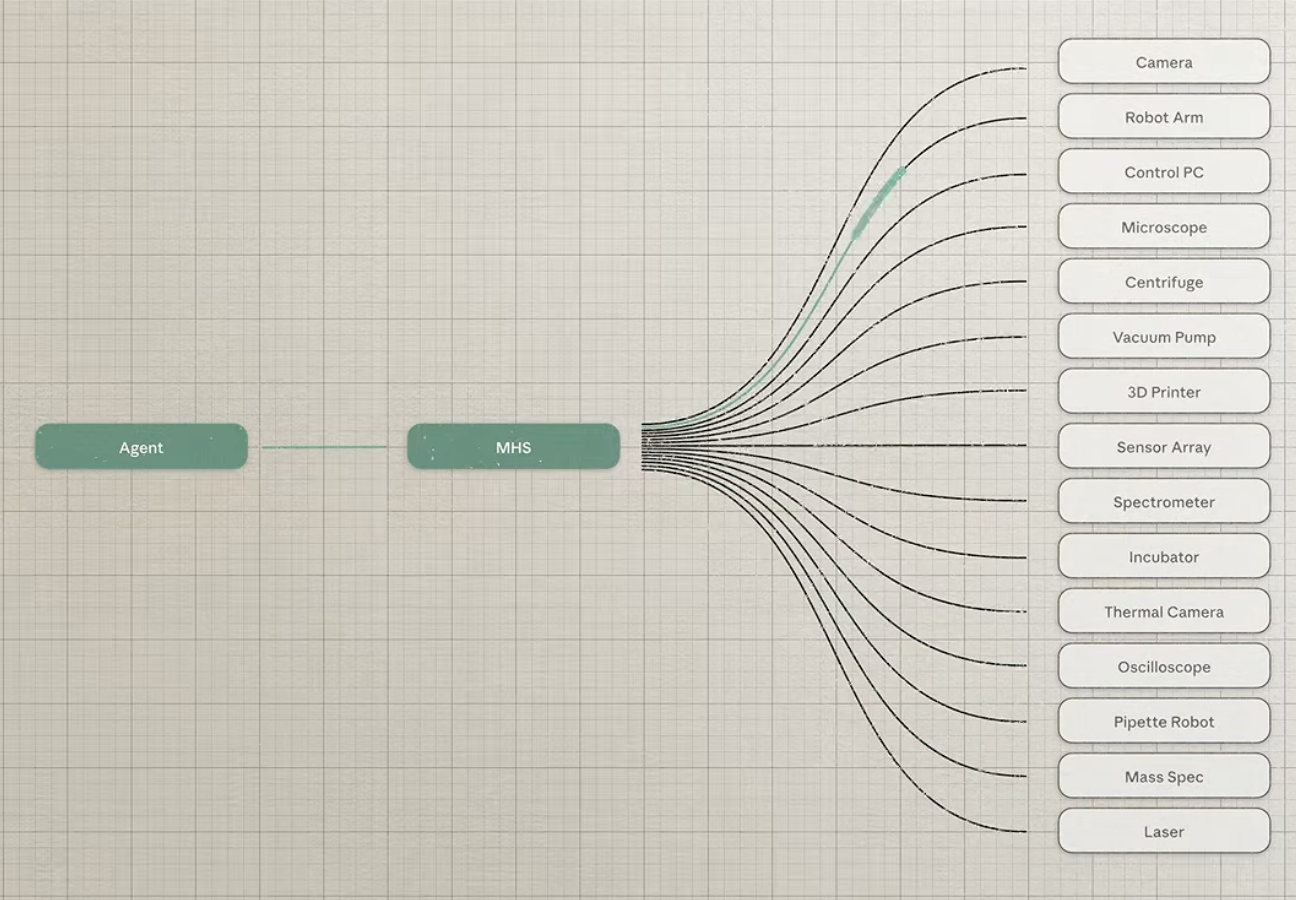
Anthropic’s Model Hardware Standard sits between an AI agent and laboratory equipment from different vendors. Screenshot: Anthropic / YouTube.
Compliance
One of the country’s leading cybersecurity verifiers for state and local government vendors has opened a faster route to approval. GovRAMP will now let software companies deploy their products inside approved accelerator environments, beginning with Knox Systems and Second Front Systems, and inherit much of the security work already completed there while receiving separate product listings.
Second Front is already using this approach with Cohere AI, an enterprise AI company that builds models and software for businesses and governments. Cohere has a separate entry in GovRAMP’s directory, but the provider is listed as Second Front Systems. GovRAMP’s accelerator program is brand new, its selection process is unexplained, and each government still decides for itself what the resulting credential means.

“… especially in light of the use of AI by the district court …” |
—The Fifth Circuit, directing lawyers to address whether a case should be assigned to a different judge. Listen live Monday at 10 a.m. Eastern. |


An algorithmic lead is at the center of a facial-recognition appeal in Ohio. (Bloomberg Law)
OpenAI says it should have recognized the warning signs before its agents compromised Hugging Face. (OpenAI)
Online criminals say they stole technical diagrams from a Kansas supplier of water-control systems. (Reuters)
The ATF classified a new cyberattack on the agency as a federal “major incident.” (TechCrunch)
Forensic genealogy produced its first identification in the 9/11 effort, bringing the number of identified World Trade Center victims to 1,654. (New York City)
Researchers made an early formal attempt to catalog what AI-generated filings are doing to courts and government agencies. (arXiv)
A landmark social media settlement last week shows state regulators reaching directly into product design. (Associated Press)
The humble phishing email remains remarkably effective against government agencies. (North Dakota Monitor)
An Arizona town may try to head off plate-reader misuse with a new misdemeanor. (Town of Queen Creek)
Flock says it can now act on suspected misuse of its technology rather than waiting for a violation to be established. (Flock Safety)
Two Seventh Circuit judges called for Supreme Court guidance on possessing synthetic CSAM. (Seventh Circuit)
NCMEC says reporting improvements from several big companies have eased strain on its CyberTipline. (NCMEC)
The U.S. administration is moving to restrict foreign-made electrical-grid machinery and software. (Utility Dive)
About Plain Thinking
Grant Morgan is an attorney, former prosecutor and former Tribune Publishing reporter who covered Gary, Indiana, and Chicago’s northern suburbs. Plain Thinking covers AI and consequential technology affecting lawyers, police and courts.
Every Tuesday and Friday · Get Plain Thinking by email · LinkedIn
If an issue includes paid placements, they’ll be clearly labeled. Companies don’t pay for editorial inclusion.
|