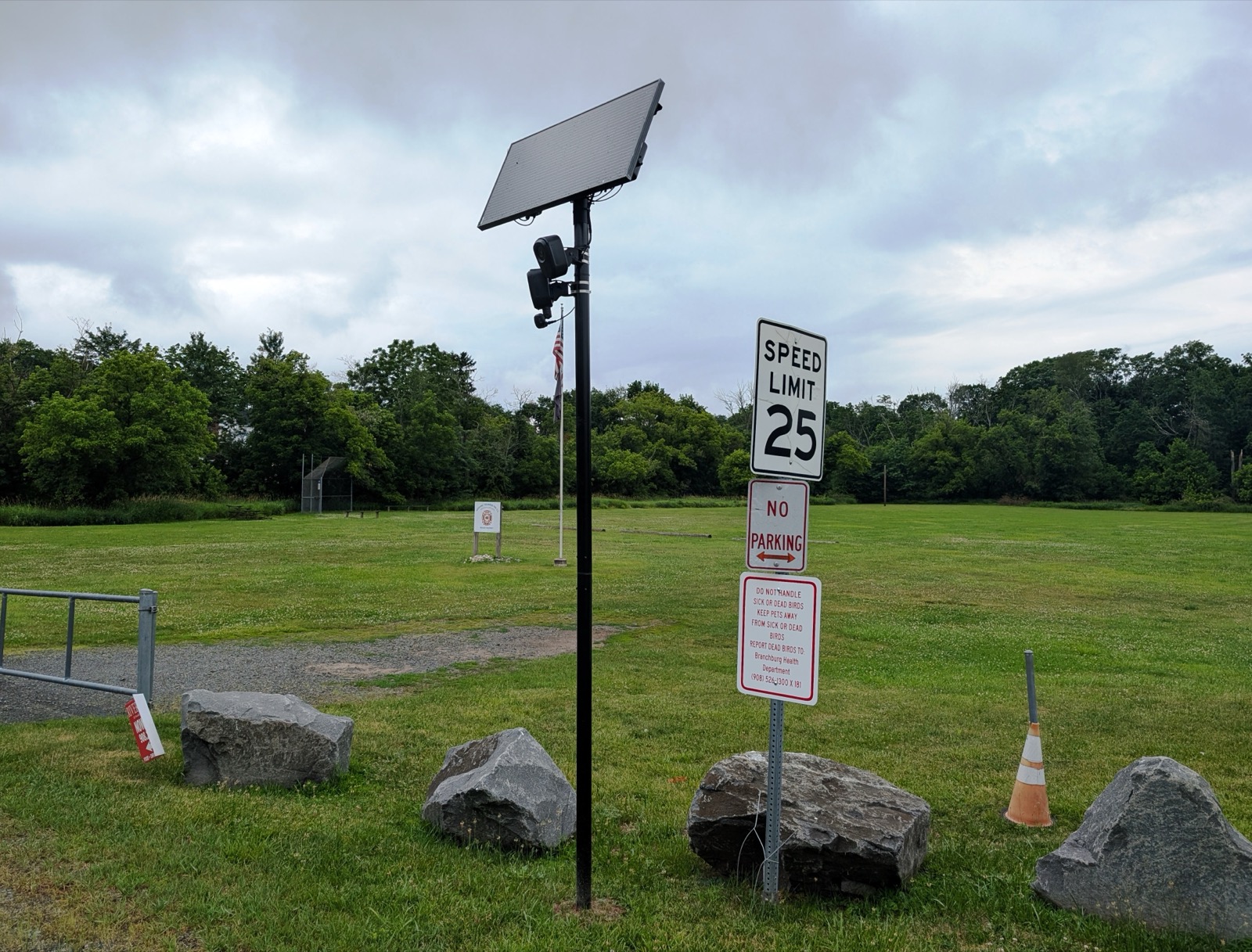
Two Flock Safety automated license plate readers in Neshanic Station, New Jersey, June 27, 2026. Photo: Mr. Matté / Wikimedia Commons, CC BY-SA 4.0.
Texas is cutting off state funding for Flock Safety’s license-plate cameras. The order came days after a Lufkin police officer was indicted on 100 counts for allegedly using the network to track his ex-girlfriend and others connected to her. A public-records request prompted an audit that found more than 10,000 searches for the woman’s plate. Gov. Greg Abbott called the order a “crackdown” on Glenn Beck’s show and said Flock cameras were being “reduced dramatically.” Texas has spent at least $30 million helping deploy about 3,200 Flock cameras — roughly one-quarter of the estimated statewide network. The order does not shut those cameras down. But after helping finance one of the country’s largest Flock networks, Texas is now using its statewide purchasing power to pull back.
| • |
Abbott’s office has not said whether the order affects unspent grants, contract renewals or the Department of Public Safety’s existing Flock network. (Texas Tribune) |
| • |
Georgia arrested a former Covington officer for alleged Flock misuse, days after charging four former Savannah police employees with similar offenses. (GBI) |
Courts
When challenged, Arizona’s Supreme Court said it would keep letting judges use AI. Earlier this year, state appellate Judge Andrew Jacobs petitioned the state’s high court to stop judges from using AI for core judicial work through 2029. Jacobs argued that using AI to draft orders or opinions was fraught with hallucination risk, undisclosed machine involvement and damage to public trust. Arizona’s AI steering committee opposed the moratorium, saying controlled use is necessary to evaluate the technology and develop safeguards. The court said judicial decision-making cannot be delegated to AI, but denied the proposed ban and ordered the committee to recommend clearer standards by March 1.
| • |
California lets judges use AI in adjudicative work but requires them to verify its output and protect confidential information. (California Courts) |
| • |
Illinois judges, clerks and court staff can use AI under existing ethical rules. (Illinois Supreme Court) |
Crime
Houston will test a new Texas law banning AI-generated CSAM. Senate Bill 1621 took effect one year ago today, extending Texas’s child-pornography statute to realistic images made by AI or other software. On Aug. 21, Harris County prosecutors filed three felony charges against Alexander Marvin Bigelow (29) for promotion of AI-generated CSAM. Deputies say they found thousands of images on an external hard drive. The first prosecution under the law will test how Texas proves that an image qualifies as AI-generated CSAM and that the defendant intended to promote it.
Number of the Day
380 volts
Maximum voltage of the electric-shock gloves ICE ordered under a $16.7 million contract for 6,000 pairs, according to manufacturer Compliant Technologies.
In Other News
An AI police scanner app turned a person’s name into a false shooting alert in Orange, Massachusetts. (Greenfield Recorder)
A small rural county in Oregon rejected an AI automation assessment. (Josephine County)
Texas has made annual AI training mandatory across state and local government. (DIR)
Texas water utilities will serve as a test bed for cyber tools from Microsoft, Google, Amazon and other companies. (CyberScoop)
Apple argues that feeding trade secrets to AI agents may make their use irreversible. (Court filing)
The USPTO reprimanded a patent lawyer for AI hallucinations. (USPTO)
A federal judge struck down the government-wide blacklist of Anthropic. (N.D. California)
OMB is expanding Login.gov across federal services while the agency that runs it explores persistent device identification. (OMB, GSA)
CISA added two security bugs in widely used print-management software to its exploited-vulnerabilities list. (CISA)
Two Nigerian men were extradited on sextortion cases involving teenage boys who died by suicide. (DOJ)
Europe is regulating a generative chatbot as a search engine. (European Commission)
Europe is spending $450 million on a giant government-owned AI computer. (EuroHPC)
About Plain Thinking
Grant Morgan is an attorney, former prosecutor and former Tribune Publishing reporter who covered Gary, Indiana, and Chicago’s northern suburbs. Plain Thinking covers AI and consequential technology affecting lawyers, police and courts.
Every Tuesday and Friday · Get Plain Thinking by email · LinkedIn
If an issue includes paid placements, they’ll be clearly labeled. Companies don’t pay for editorial inclusion.