 | AI evidence rules remain unsettled |
 John Joseph Moakley U.S. Courthouse, Boston. Photo: Beyond My Ken / Wikimedia Commons, CC BY-SA 4.0. Federal rulemakers still have plenty to resolve on AI evidence. On Thursday, the Advisory Committee on Evidence Rules — the body that recommends changes to federal evidence rules — met in Boston to hear from researchers, lawyers and technology companies about deepfakes and AI-generated conclusions. The committee is considering two proposals. One would amend Rule 901, the existing rule on authenticating evidence, to address claims that evidence was fabricated with AI. The other would create an entirely new Rule 707, applying the reliability standards used for expert testimony to AI-generated conclusions offered without an expert. Both proposals were sent to subcommittees for further study before the full committee meets again April 14.
On the proposed Rule 901 amendment, speakers offered different accounts of how often suspected deepfakes are surfacing. Hany Farid, a Dartmouth professor and digital-forensics expert, reported increasing inquiries, though he cautioned that the trend was anecdotal. Sean Broderick, who helps federal defenders with litigation technology, said he had seen little demand for expert assistance so far but warned about the cost and availability of qualified help. OpenAI’s Shira Anderson cautioned against relying on unreliable detection products.
The separate Rule 707 proposal drew disagreement over how to distinguish AI-generated conclusions from ordinary uses of software. DOJ’s Josh Goldfoot warned that an unclear definition could create disputes over investigative tools and evidence of crimes committed with AI. Federal-defense representative Nicole Owens emphasized the risk of expert-like conclusions reaching juries through witnesses who cannot explain their reliability, citing a Florida trial in which an officer used ChatGPT to narrow license-plate-reader records. Law professor Andrea Roth urged the committee to consider whether “computer-generated” would be a better boundary than “AI.”
Much remains unsettled, from which evidence the rules should cover to how lawyers can challenge it. Plain Thinking will explore those issues in further coverage of the meeting.
OpenAI
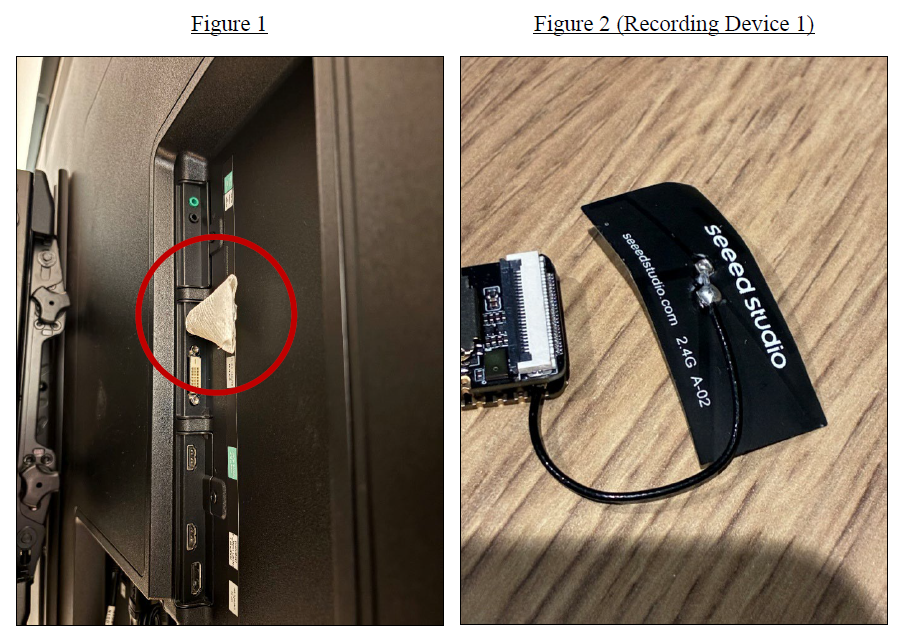
The recorder and its placement behind a television, as shown in the criminal complaint. Source: U.S. Department of Justice.
An OpenAI engineer is accused of planting a recording device in his employer’s executive conference room. Abdulrahman Alfozan, 35, was arrested October 9 on a federal wiretapping charge after employees found a recorder behind a television, concealed in toilet paper. According to the criminal complaint, a chatbot account associated with his spouse contained prompts about building and concealing recording devices — including the hidden recorder’s unique network address.
The room hosted confidential discussions about research, products and government engagements. Alfozan, a Saudi national, is also listed as a venture partner at Raed Ventures, a Riyadh-based investment firm. The complaint does not allege that he acted for Raed or the Saudi government.
Quotable“This company collected some of the most private thoughts children have ever shared … conversations could be sold off to the highest bidder.” — Letitia James, New York attorney general, on protecting users’ chats in Character.AI’s bankruptcy. AI privacy

An older view of Character.AI’s character-selection screen. Screenshot: Character.AI, via Hotelemarketer (2023).
Character.AI’s bankruptcy could put users’ private conversations in new hands. The company, whose chatbots let users converse with fictional characters and AI companions, filed for bankruptcy Monday after losing roughly $8 million to $9 million a month. Disney has offered $20 million for certain intellectual-property rights, but the platform’s future remains uncertain. Character.AI says it will shut down if no buyer agrees to keep it running.
State attorneys general stepped in Wednesday, seeking protections for the sensitive information the company holds, including children’s conversations and users’ health disclosures. They want users to have a chance to delete their data before any sale and limits on using chats for advertising or AI training without proper consent. They also want any new owner to keep restrictions on children’s use of the chatbots. (Read the filing.)
Number of the Day$68 million What Google will pay to settle claims its voice-activated devices recorded private conversations without permission. A third will go to attorneys’ fees.
In Other News
A New Jersey deputy attorney general was arrested over allegations he created and shared AI-generated child sexual abuse images. (FOX 29)
A cybersecurity incident halted bankruptcy notices nationwide after hitting systems operated by BAE Systems. (Infosecurity Magazine)
OpenAI disclosed another instance of its AI breaking into a website, this time to retrieve government hospital-bed statistics. (OpenAI)
A Wisconsin litigant unsuccessfully accused a judge of bias for suggesting his filings were AI-generated. (Court order)
A Colorado federal judge offered her perspective on AI in litigation in a recent essay. (Federal Bar Association)
A Nevada federal judge ruled that an expert must disclose some, but not all, of his ChatGPT history to opposing lawyers. (Hunton Andrews Kurth)
Cleveland schools are caught in a Flock data-sharing snafu. (Signal Cleveland)
Pennsylvania is testing a tool that lets sexual-assault survivors track their evidence kits. (StateScoop)
A bipartisan pair of senators asked the White House to help state and local governments use AI to fight cyberattacks. (Senate Commerce Committee)
Microsoft joined OpenAI, Anthropic and Google in offering AI tools for lawyers. (LawSites)
Meta and Nvidia released AI models for local use: Muse Spark Open and Nemotron 3.5 Bolt. (Meta; Nvidia)
Massachusetts and Iowa are pushing for AI safety checks through proposed rules and a lawsuit against OpenAI. (MassLive; Pluribus News)
The FTC reportedly subpoenaed OpenAI and Anthropic over AI safety incidents. (Axios)
Florida won an appeals-court ruling backing its limits on children’s social-media accounts. (Court opinion)
GitLab patched a critical flaw that could let attackers run code on its servers without logging in. (BleepingComputer)
A U.S. company was fined more than twice its investment for failing to report a stake in a Chinese AI company. (Treasury)
Google and Singapore are developing AI to spot scam messages without sending private chats off users’ phones. (Google DeepMind)
About Plain Thinking
Grant Morgan is an attorney, former prosecutor and former Tribune Publishing reporter who covered Gary, Indiana, and Chicago’s northern suburbs. Plain Thinking covers AI and consequential technology affecting lawyers, police and courts.
Every Tuesday and Friday · Get Plain Thinking by email · LinkedIn
If an issue includes paid placements, they’ll be clearly labeled. Companies don’t pay for editorial inclusion.
| 