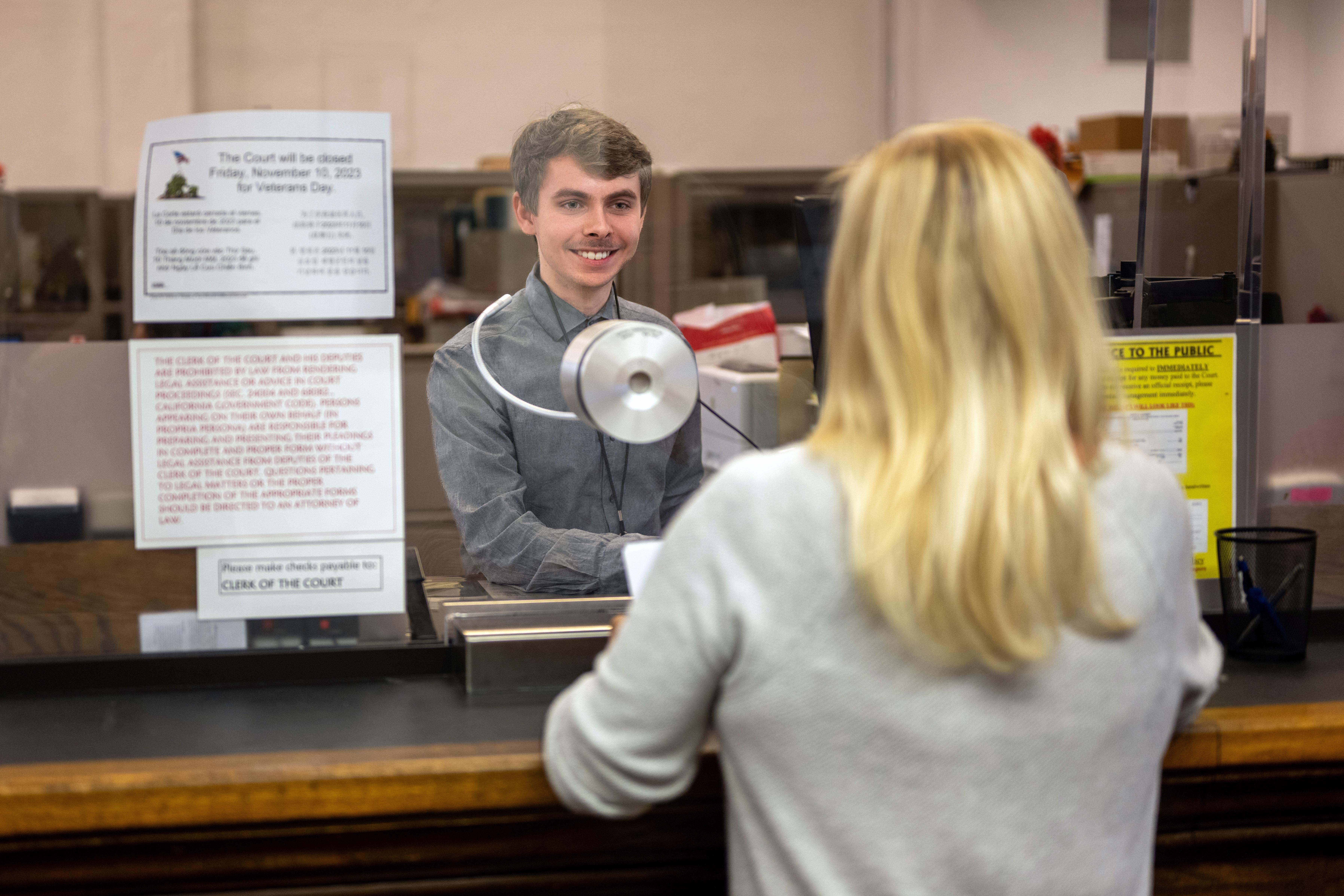
A clerk assists a visitor at Santa Barbara County Superior Court. Photo: Santa Barbara County Superior Court.
For nearly five years, some California courts used an app to translate conversations between court staff and people seeking help. The app used Google’s translation technology at clerk’s counters and self-help centers in counties including Alameda, Orange, Sacramento and San Diego. People used it to ask about evictions, family law and court filings. In one exchange, the app recorded “Sting the judge to reduce a fever.” Eighteen seconds later, the log reads “ask the judge to reduce the fine.” Staff feedback was mixed: some praised the app, while others reported problems with legal terms and speech recognition. The app shut down in April. Legal-aid groups objected last week to plans for a replacement, warning that translation errors could distort legal information and miscommunicate court procedures.
- California’s court administration canceled its request for a replacement app October 15 without giving a reason in the posting. (Judicial Council of California)
- ChatGPT’s upgraded voice mode won over a reviewer by keeping up with rapid-fire Spanish soccer commentary. (Tom’s Guide)
Risk

Los Banos substation in California. Photo: JPxG / Wikimedia Commons · CC BY-SA 4.0.
Electric utilities may not fully understand the AI they’re using. In a report last week, federal auditors said utilities’ safeguards are slow to catch up as vendors add AI to their products. The concern is what AI tools can access and do inside systems that support the power grid. Recent real-world intrusions, the report said, show how attackers can exploit AI tools to find paths into critical systems. We previously covered attacks on water utilities and a federal warning about hackers using AI to target industrial controllers. In last week’s report, auditors said utilities generally had appropriate controls, but urged them to limit AI access and monitor connections outside protected networks. Elsewhere:
Social Media
Discord on a smartphone. Photo: appshunter.io / Unsplash.
Florida is seeking greater control over how technology companies operate. The state sued Discord — a messaging platform — last week, alleging its recent safety changes still leave minors vulnerable to unwanted contact from adults. (Discord disputes the allegations.) The lawsuit extends Florida’s campaign against platforms it accuses of misleading parents and endangering children, including Roblox, Snapchat, TikTok and Meta. A day before the Discord filing, a federal court backed the state’s law barring kids under 14 from having accounts on certain major social-media platforms, finding it likely to survive a First Amendment challenge. Elsewhere:
In Other News
Michigan police packed an AI-generated photo, facial recognition and Flock into one undercover sting. (404 Media)
Reno, Nev., is weighing a $21.8 million Axon package that includes drones, plate readers and AI report drafting. (This Is Reno)
Denver’s council rejected a $3.9 million renewal and expansion of its city-services chatbot amid questions about accuracy and staffing. (Denverite)
Tempe, Ariz., banned police use of automatic plate readers, with some exceptions. (KJZZ)
A convicted robber in Texas is asking a federal appeals court to require warrants for Flock tracking. The same court upheld more limited plate-reader use in March. (Texas Tribune)
A Savannah, Ga., officer was fired for sharing her Flock login with her husband, an ICE agent, amid a string of misuse cases in the company’s home state. (WJCL)
A Texas officer is under criminal investigation after a newly required audit uncovered his misuse of Motorola’s Vigilant license-plate reader system. (KBTX)
For now, Colorado doesn’t have to turn over records from convicted DNA analyst “Missy” Woods’s other cases to a murder defendant awaiting retrial. (The Denver Gazette)
After citing nonexistent cases, a pro se litigant must now certify whether she used AI even in emails to opposing counsel. (Court order)
AI did not help an Ohio man reopen a stalking case. (Court opinion)
A tax-news publisher is suing the IRS for records describing how it uses AI to select partnerships for audits. (Court filing)
The Brooklyn DA led an unusually far-reaching cyber takedown for a local prosecutor’s office. (Brooklyn DA)
University of Toronto researchers documented spyware infections requiring no click, one involving online ads and another targeting a Serbian university leader. (Citizen Lab)
Hackers used AI agents to break into websites linked to more than 100 companies, including John Deere and SharkNinja. (Reuters)
The U.S. government disclosed Monday that it banned China’s DeepSeek from civilian agencies in July. (DHS)
Voting-rights and privacy groups sued the Department of Homeland Security, alleging it unlawfully collected voters’ personal data. (Kentucky Public Radio)
The EU’s police agency calls even 99%-accurate AI forensic analysis unusable unless its steps can be demonstrated. (Europol; European Commission)
About Plain Thinking
Grant Morgan is an attorney, former prosecutor and former Tribune Publishing reporter who covered Gary, Indiana, and Chicago’s northern suburbs. Plain Thinking covers AI and consequential technology affecting lawyers, police and courts.
Every Tuesday and Friday · Get Plain Thinking by email · LinkedIn
If an issue includes paid placements, they’ll be clearly labeled. Companies don’t pay for editorial inclusion.